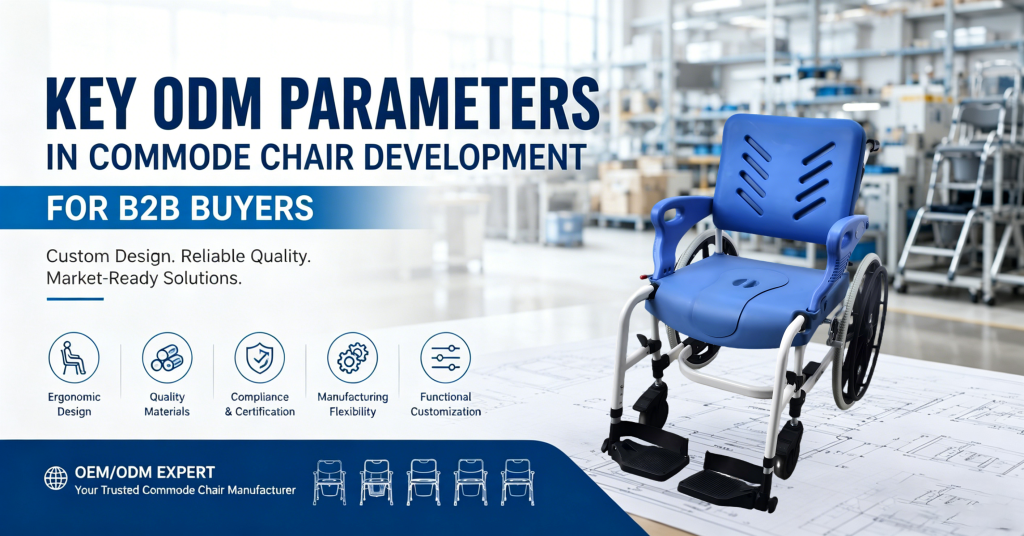
When developing a commode chair for international markets, product customization is no longer limited to logo printing or packaging adjustments. For B2B buyers, especially importers, distributors, healthcare suppliers, and private-label brands, ODM development directly affects market positioning, compliance readiness, long-term durability, and user satisfaction.
A well-structured ODM process allows buyers to adapt products to regional market needs while maintaining manufacturing consistency and regulatory compliance.
For buyers still comparing suppliers, it is also important to understand how to evaluate a reliable commode chair manufacturer in China
Ergonomic Design and Structural Stability

Ergonomics is one of the most important considerations in commode chair development, particularly for elderly users and individuals with limited mobility.
During ODM customization, buyers typically evaluate:
- Weight capacity requirements
- Seat width and depth
- Adjustable height ranges
- Armrest support strength
- Foldable frame structure
These parameters influence both safety and user comfort.
For example, wider seat dimensions may be preferred in bariatric care markets, while compact foldable designs are often more suitable for distributors targeting smaller residential spaces.
Structural stability is equally critical. Reinforced aluminum frames, anti-slip foot pads, and balanced weight distribution all contribute to long-term product reliability.
Material Selection for Different Market Environments

Material selection plays a major role in product durability and regional adaptability.
In high-humidity environments such as bathrooms and rehabilitation centers, corrosion resistance becomes essential. Many distributors therefore prefer aluminum alloy frames because they are lightweight, rust-resistant, and easier to maintain over time.
Common customizable material options include:
- Aluminum alloy frames
- EVA or PU padded seats and backrests
- Anti-slip rubber foot tips
- Removable plastic commode buckets
Each material choice affects durability, cleaning efficiency, and user experience.
For buyers supplying premium healthcare markets, soft-touch seating materials and upgraded surface finishes may also improve product positioning.
Compliance and Certification Requirements

For medical and rehabilitation equipment, compliance should be considered during the design stage rather than after production begins.
A qualified ODM manufacturer should be able to support:
- CE requirements for European markets
- FDA-related compliance processes for the United States
- ISO 13485 quality management standards
- Market-specific documentation requirements
Ignoring these requirements early in development often leads to delays, redesign costs, or registration issues later.
If your target market involves strict regulatory standards, reviewing broader medical device compliance requirements
can help reduce long-term risks.
Manufacturing Flexibility and Low MOQ Capability
Manufacturing flexibility has become increasingly important for distributors testing new markets or launching private-label products.
Low MOQ customization allows buyers to:
- Reduce inventory pressure
- Validate market demand more efficiently
- Test multiple product configurations
- Expand product lines gradually
At KDB Medical, commode chair ODM projects can start from relatively small quantities while maintaining the same production standards used for larger orders.
This helps buyers balance customization flexibility with manufacturing consistency.
Functional Customization for Regional Markets
Different markets often prioritize different product features.
Examples include:
- Detachable buckets for easier cleaning
- Wheeled models for homecare mobility
- Rust-resistant hardware for humid regions
- Lockable armrests for additional safety
- Foldable structures for compact storage
These functional adjustments allow distributors to better match local user preferences and healthcare environments.
In competitive markets, small functional differences often have a direct impact on product acceptance and long-term customer satisfaction.
Why ODM Parameters Matter for Long-Term Competitiveness
ODM customization is not simply about modifying product appearance. It directly affects:
- Product differentiation
- Regulatory readiness
- Supply chain stability
- End-user experience
- Long-term brand competitiveness
For B2B buyers, choosing a manufacturer that understands both compliance requirements and market adaptability can significantly reduce operational risk while improving long-term product performance.
Conclusion
Successful commode chair ODM development requires more than flexible manufacturing. It depends on balancing ergonomics, material selection, compliance, and market-specific customization within a stable production system.
For distributors and healthcare equipment brands, understanding these key parameters helps create products that are better aligned with both regulatory expectations and end-user needs.
If you are evaluating suppliers for future ODM projects, selecting an experienced commode chair manufacturer with established compliance and customization capabilities can provide stronger long-term support.
