A successful OEM project does not always begin with a completely new product idea.
Sometimes, it begins with an existing product that is already close to what the buyer needs — but not quite right for their market.
That was the starting point of this custom reclining commode chair project.
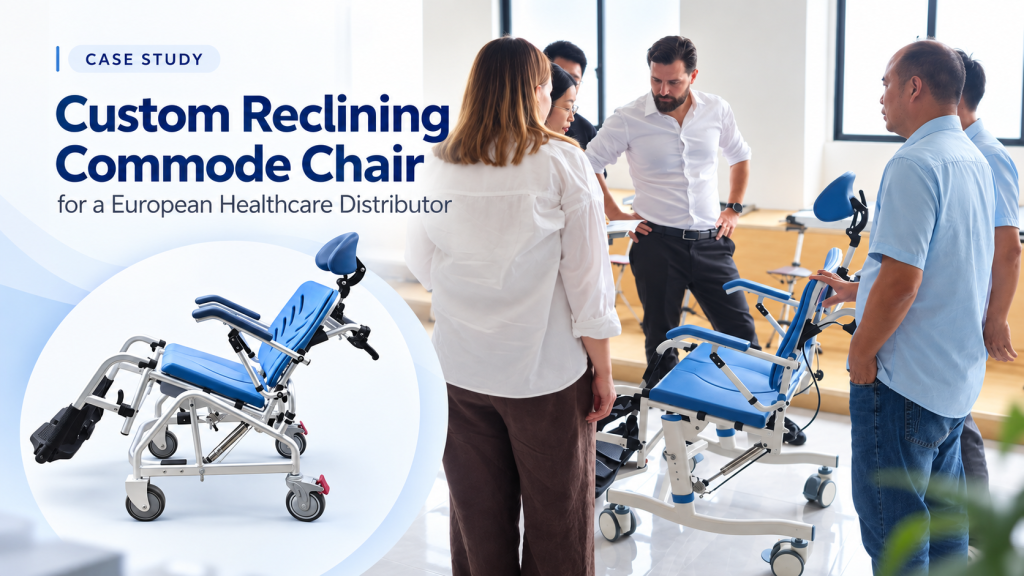
A European healthcare distributor visited KDB Medical to evaluate our products and manufacturing capabilities in person. During the visit, the customer examined one of our existing reclining commode chair models and discussed how the product could be better adapted to the needs of their local market.
Instead of simply selecting the standard model, the customer brought specific market feedback and product requirements to the discussion.
Based on those requirements, our team reviewed the existing design and developed a customized solution, including changes to the lower frame and base structure.
The result was a reclining commode chair configuration developed around the customer’s market requirements rather than a standard catalog specification.

From Factory Visit to Product Requirement
The project began with an on-site evaluation.
During the factory visit, the customer was able to inspect the reclining commode chair directly rather than relying only on product photos, videos or specification sheets.
This gave both sides an opportunity to discuss the product in practical terms.
The existing model already provided many of the functions the customer was looking for, but the buyer also identified differences between the standard configuration and what they wanted for their own market.
This is an important part of B2B product development.
A distributor often understands local purchasing preferences, usage scenarios and market expectations better than a manufacturer operating thousands of kilometers away.
The manufacturer’s role is different: to determine whether those market requirements can be translated into a practical and manufacturable product solution.
In this project, the existing reclining commode chair therefore became the starting platform, not the final answer.
Identifying What Needed to Change
Rather than redesigning the entire chair without a clear reason, the discussion focused on the areas that actually needed to be different.
One of the main requirements involved the lower frame and base structure.
The customer wanted a configuration that better matched the characteristics and needs of their target market.
Our team therefore reviewed the existing structure together with the requested changes and considered how the revised design could be integrated into the complete chair.
This type of project is very different from simple private labeling.
Changing a logo, color or carton does not normally affect the engineering of a product.
Changing the frame structure can.
A structural modification may influence:
- Frame geometry
- Component positioning
- Wheel or support locations
- Overall dimensions
- Assembly
- Manufacturing feasibility
- Product balance
- Packaging
For this reason, the requested change had to be evaluated as part of the complete product rather than as an isolated component.
Engineering the Customized Reclining Commode Chair
After the customer’s requirements were clarified, the project moved into engineering evaluation.
The existing reclining chair platform provided a useful foundation because the project did not require every function to be developed from zero.
Instead, the engineering work focused on adapting the areas that were relevant to the customer’s request.
The lower frame and base structure were revised to create a different product configuration while retaining the core reclining-chair concept.
This approach is often practical for OEM projects because it combines two advantages:
An existing product platform provides a proven development starting point.
Market-specific modifications create differentiation for the buyer.
The objective is not to make a product different simply for the sake of customization.
The objective is to make the changes that are relevant to the buyer’s market.

From Standard Product to Market-Specific Solution
The finished configuration demonstrates a common path in OEM medical and rehabilitation equipment development:
Existing Product → Market Feedback → Engineering Review → Structural Modification → Customized Solution
This process is especially useful when a buyer finds a product that already meets most of their requirements but still needs several important changes.
In those situations, there may be little commercial value in developing a completely new chair from the ground up.
A more practical approach can be to retain the parts of the existing platform that already work and concentrate engineering resources on the areas that need differentiation.
For the customer, this can also make product discussions much clearer.
Instead of describing a concept only with drawings or reference images, the buyer can evaluate a physical product and say:
- Which functions should remain
- Which structures should change
- Which requirements come from the local market
- Which features are commercially important
- Which modifications are unnecessary
That makes the development process more focused.
Why Local Market Feedback Matters in OEM Development
Rehabilitation equipment is sold globally, but purchasing requirements are not identical across markets.
A product that fits one market may need changes before it is suitable for another.
Differences can come from many areas, including:
- Buyer preferences
- Distribution channels
- Bathroom or care environments
- Product positioning
- Local competition
- Packaging expectations
- Institutional requirements
- Retail or e-commerce considerations
This is why experienced distributors can play an important role in OEM development.
They bring local market information that the manufacturer may not have.
The manufacturer, meanwhile, brings knowledge of product engineering, materials, components and production feasibility.
A productive OEM project combines both.
The buyer provides market insight.
The manufacturer converts that insight into a manufacturable product.
This project followed that logic.
Customization Is More Than Logo, Color and Packaging
In many sourcing discussions, the word “customization” is used very broadly.
There is an important difference between commercial customization and product engineering customization.
Commercial customization may include:
- Logo
- Labels
- Color
- Instructions
- Retail packaging
- Carton markings
Engineering customization may involve:
- Frame structure
- Product dimensions
- Component configuration
- Functional mechanisms
- Mobility structure
- Materials
- Accessories
- Structural interfaces
Both approaches can be useful.
The appropriate level depends on what the buyer is trying to achieve.
For this European distributor project, the requirement went beyond branding. The product itself needed structural adaptation.
For healthcare brands planning similar programs, our Private Label Commode Chair Solutions for Healthcare Brands guide explains the broader private-label and customization process.
A Practical OEM Development Workflow
This project can be summarized in five stages.
1. On-Site Product Evaluation
The customer visited KDB Medical and evaluated an existing reclining commode chair in person.
2. Market Requirement Discussion
The buyer explained the differences between the standard model and the configuration required for their target market.
3. Engineering Review
Our team evaluated the requested changes against the existing product structure and manufacturing feasibility.
4. Structural Modification
The lower frame and base structure were revised according to the agreed development direction.
5. Customized Product Configuration
A new reclining commode chair configuration was developed around the customer’s specific requirements.
The important point is that the process began with a real market requirement, not with customization for its own sake.
What B2B Buyers Can Learn From This Project
For distributors and healthcare brands, this case highlights several practical points.
First, a catalog model does not always have to be accepted exactly as it is.
If the product is close to what the market needs, it can sometimes provide the foundation for a more specific solution.
Second, the most useful product-development discussions are usually concrete.
A physical sample, real product dimensions, structural references and clearly defined market requirements make engineering communication much more efficient than vague requests such as “make it more suitable for our market.”
Third, structural customization should be evaluated differently from cosmetic customization.
A change to a frame or base may affect multiple areas of the product and therefore needs engineering review.
Finally, a distributor’s local market knowledge can be valuable product-development input.
Manufacturers do not need to guess every market requirement independently when the buyer can provide direct feedback from the market they serve.
Building a Product Around the Market, Not Only the Catalog
For KDB Medical, this project represents the type of OEM/ODM cooperation where an existing product becomes the starting point for a more market-specific solution.
The customer did not simply choose a reclining commode chair from a catalog.
They evaluated the product, identified what needed to be different and discussed those requirements directly with our team.
The engineering process then focused on converting that feedback into a practical product configuration.
That is the main value of this case:
Not every buyer needs a completely new product.
Sometimes the better solution is to start with the right platform and modify the parts that matter.
Looking for a Custom Reclining Commode Chair Solution?
If you are a healthcare distributor, rehabilitation equipment brand, importer or project buyer and an existing commode chair is close to what your market needs but still requires structural or functional changes, KDB Medical can evaluate the project with your team.
You can provide an existing model, product reference, drawing, target specification or market requirement as the starting point.
Contact us for product evaluation, samples, OEM/ODM development, private label options or a customized commode chair solution for your market.
