
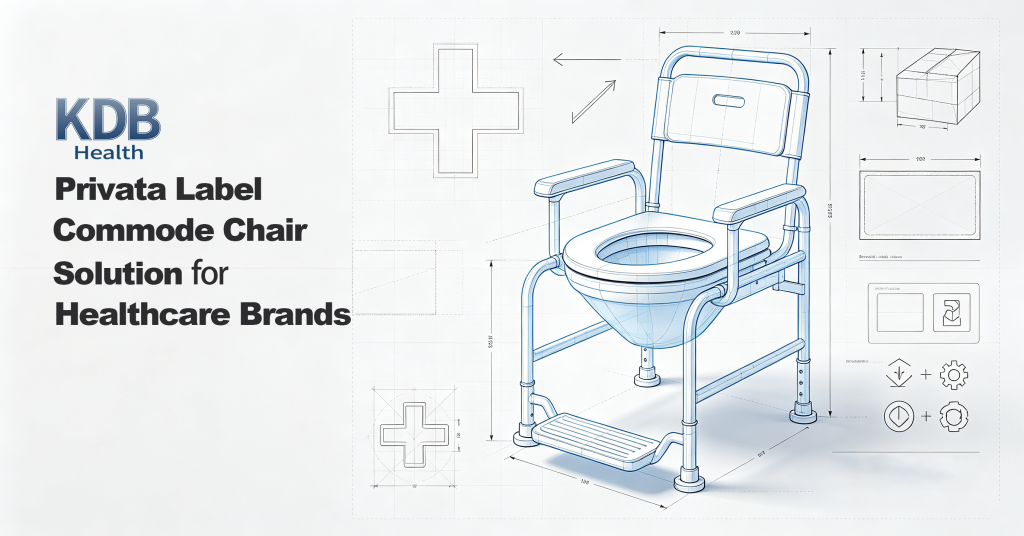
Healthcare brands, distributors, and medical equipment importers increasingly look beyond standard catalog products when building their rehabilitation equipment portfolios. For companies competing in home care, elderly care, and institutional healthcare markets, private label commode chairs can provide an opportunity to develop a differentiated product line while maintaining control over branding, product specifications, and market positioning.
A successful private label program, however, requires more than adding a logo to an existing commode chair. Product structure, materials, functionality, packaging, quality control, documentation, and manufacturing consistency all influence the long-term success of a branded healthcare product.
For healthcare companies evaluating a private label commode chair manufacturer, the key question is therefore not simply whether a factory can customize a product, but whether the manufacturer can support the complete development and supply process.
Key Takeaways
- Private label commode chairs allow healthcare brands to develop products under their own brand identity.
- Effective private label manufacturing can involve product configuration, colors, packaging, labeling, and selected structural modifications.
- OEM and ODM capabilities provide different levels of customization and engineering support.
- A reliable manufacturing partner should have appropriate quality systems, engineering capabilities, production capacity, and after-sales support.
- Long-term private label programs depend on consistent product quality and stable supply, not only the initial product customization.
What Is a Private Label Commode Chair?
A private label commode chair is a healthcare product manufactured by one company and sold under another company’s brand.
The manufacturer typically provides the production capability, while the customer controls the commercial brand and market positioning.
Depending on the project, private label customization may include:
- Brand logo and labeling
- Product colors
- Packaging design
- Product configuration
- Accessories
- User manuals and documentation
- Selected structural or functional modifications
The level of customization depends on the manufacturer’s engineering capabilities and the requirements of the project.
For distributors and healthcare brands, this model can provide greater control over their product portfolio without requiring them to establish their own manufacturing facility.
Why Healthcare Brands Use Private Label Commode Chairs
Standard products can be useful for companies that need to enter a market quickly. However, relying entirely on identical catalog products can make differentiation difficult.
A private label strategy can help healthcare brands establish a more consistent product identity.
1. Build a Distinctive Product Portfolio
Instead of selling a product that is also available from many competing distributors, a healthcare company can develop a branded commode chair range with its own:
- Product appearance
- Color system
- Packaging
- Product configuration
- Brand positioning
This can make the product portfolio easier for customers to recognize.
2. Match Products to Specific Markets
Different healthcare markets have different requirements.
For example, distributors serving home-care customers may prioritize:
- Compact dimensions
- Easy cleaning
- Lightweight construction
- Comfortable seating
- Adjustable features
Institutional buyers may place greater emphasis on:
- Durability
- Load capacity
- Cleaning efficiency
- Stable supply
- Documentation
- Product consistency
A private label project allows the buyer and manufacturer to determine which specifications are most appropriate for the intended market.
3. Develop Long-Term Brand Value
Private label manufacturing can become more valuable when it develops into a long-term product program rather than a one-time purchase.
Once a product configuration has been validated, the buyer can establish a repeatable supply chain around the product.
This may include:
- Consistent specifications
- Standardized packaging
- Repeat production
- Product improvements
- New related models
The result is a more coherent rehabilitation equipment portfolio.
Private Label vs OEM vs ODM Commode Chairs
The terms private label, OEM, and ODM are sometimes used interchangeably, but they describe different levels of cooperation.
| Manufacturing Model | Typical Customization | Engineering Involvement | Suitable For |
|---|---|---|---|
| Standard Product | Logo and basic packaging | Low | Buyers seeking existing products |
| Private Label | Branding, packaging, selected configurations | Low to medium | Distributors and healthcare brands |
| OEM | Customer-provided design/specifications | Medium to high | Established brands with their own product designs |
| ODM | Joint product development and customization | High | Brands developing differentiated products |
Private label is therefore not necessarily a separate manufacturing technology. It is primarily a commercial and branding model that can be supported through different levels of OEM or ODM cooperation.
For more complex product development projects, an experienced OEM/ODM commode chair manufacturer can provide additional engineering support.
What Can Be Customized on a Private Label Commode Chair?
The practical customization scope should be discussed with the manufacturer before the project begins.
Branding and Identification
The most basic level of private label customization may include:
- Brand logo
- Product labels
- Packaging
- User manuals
- Carton markings
This approach is suitable for companies that already have a preferred product configuration and primarily need brand differentiation.
Product Configuration
Depending on the manufacturer’s existing platform, customers may be able to select or modify:
- Seat width
- Seat height
- Armrest configuration
- Footrest configuration
- Casters
- Backrest design
- Commode bucket configuration
- Frame structure
The exact options depend on the product platform and engineering feasibility.
Appearance and User Experience
For brands with stronger positioning requirements, customization may also involve:
- Product color
- Cushion materials
- Surface treatment
- Packaging appearance
- Ergonomic details
These elements can help create consistency across a branded healthcare product portfolio.
Structural Customization
More advanced projects may require changes to the physical structure.
Examples can include:
- Reinforced frames
- Different seat dimensions
- Modified support structures
- Special caster configurations
- Changes to folding or adjustment mechanisms
Structural changes should be evaluated by engineers rather than treated simply as cosmetic customization.
Engineering Capability Matters More Than Logo Customization
A private label healthcare product carries the customer’s brand reputation.
For that reason, manufacturing capability becomes especially important when customization goes beyond packaging.
An experienced commode chair manufacturer should be able to evaluate:
- Structural strength
- Material selection
- Load-bearing performance
- Product stability
- Manufacturing tolerances
- Assembly consistency
- Quality inspection requirements
This is particularly important for rehabilitation equipment because the product may be used by elderly people, patients, and caregivers in daily-care environments.
KDB Medical is a rehabilitation equipment manufacturer specializing in commode chairs, shower chairs, patient lifts, and related elderly-care equipment. The company integrates R&D, manufacturing, quality control, sales, and after-sales support.
Its manufacturing capabilities include an in-house R&D team, ISO 13485-certified quality management, multiple patented designs, and more than 500 private molds.
These capabilities allow the factory to support both standard product supply and customized OEM/ODM projects.
Quality Control for Private Label Healthcare Products

Private label products carry the buyer’s brand, so quality problems can directly affect the distributor or healthcare brand.
A private label program should therefore define quality requirements before mass production begins.
Important areas include:
Incoming Material Control
Materials and components should be checked according to defined specifications.
Production Process Control
Critical production processes should have appropriate inspection and control procedures.
Assembly Inspection
Components such as frames, casters, armrests, footrests, and moving mechanisms should be checked for correct assembly and function.
Final Product Inspection
Finished products should be inspected against agreed specifications before shipment.
Documentation
Depending on the target market and product, buyers may require technical documents, inspection records, product specifications, certificates, or other compliance-related documentation.
For healthcare brands, the manufacturer’s quality management system should therefore be evaluated alongside the physical product itself.
MOQ and Private Label Development

Minimum order quantity is another important consideration for healthcare brands.
Large established brands may be comfortable placing high-volume orders, while regional distributors and growing healthcare companies may need smaller initial quantities to test market acceptance.
A flexible manufacturer may provide different options for:
- Existing product private labeling
- Small-batch customization
- New product development
- Packaging customization
- Repeat production
KDB Medical supports small-batch customization projects and can discuss MOQ requirements according to the product configuration, customization scope, materials, tooling, and packaging requirements.
For new product development, the MOQ should not be evaluated separately from engineering and tooling requirements. A project involving a completely new structure may require different development conditions from a private label project based on an existing product platform.
How to Evaluate a Private Label Commode Chair Manufacturer
Before selecting a supplier, healthcare brands should evaluate the manufacturer from several perspectives.
Manufacturing Capability
Ask:
- Does the company operate its own production facility?
- What is its production capacity?
- Which rehabilitation products does it manufacture?
- Can it support repeat orders?
Engineering Capability
Ask:
- Does the manufacturer have an in-house R&D team?
- Can it modify existing structures?
- Can it develop new products?
- Can it provide prototypes before mass production?
Quality Management
Check:
- Quality management certification
- Inspection procedures
- Production quality control
- Product testing capability
- Documentation
Customization Capability
Clarify whether the factory can support:
- Logo
- Packaging
- Color
- Product configuration
- Structural modification
- New product development
Supply Chain and After-Sales Support
A long-term private label partner should also provide:
- Stable production
- Clear communication
- Spare parts support
- Technical assistance
- After-sales service
The lowest initial price does not necessarily represent the lowest total sourcing cost. Product consistency, defect rates, delivery reliability, engineering support, and after-sales service can have a significant impact on the total cost of ownership.
From Private Label Product to a Complete Rehabilitation Portfolio
Once a private label commode chair program becomes established, healthcare brands can gradually expand their product portfolio.
For example, a distributor may initially introduce one commode chair and later develop a broader range including:
- Shower chairs
- Transfer chairs
- Patient lifts
- Walking aids
- Bedside safety products
This approach allows the brand to develop a more consistent rehabilitation equipment portfolio instead of relying on unrelated products from multiple suppliers.
For buyers considering this strategy, choosing a manufacturer with experience across several rehabilitation equipment categories can simplify product development and supply-chain coordination.
Questions to Discuss Before Starting a Private Label Project
Before requesting a quotation, healthcare brands should prepare several basic requirements:
- What market will the product serve?
- What type of users will use the product?
- What product specifications are required?
- What level of customization is needed?
- What is the expected initial order quantity?
- What certifications or technical documents are required?
- What packaging and labeling requirements apply?
- Is the project based on an existing product or a new design?
- What is the expected development timeline?
- What level of after-sales and spare-parts support is required?
Providing these details at the beginning can help the manufacturer evaluate the project more accurately and recommend an appropriate development route.
Building a Reliable Private Label Supply Partnership
Private label manufacturing works best when the relationship extends beyond the first purchase order.
A reliable manufacturing partner should understand that the customer’s brand depends on consistent product quality and dependable supply.
KDB Medical has worked with distributors, wholesalers, and healthcare businesses in multiple international markets, supporting customized rehabilitation equipment projects and long-term product supply.
The objective is not simply to manufacture a product with a customer’s logo. It is to provide the engineering, manufacturing, quality, and supply-chain support required to develop a product that the customer can confidently build into its own healthcare brand.
Frequently Asked Questions
What is a private label commode chair?
A private label commode chair is manufactured by a supplier and sold under the customer’s own brand. Customization may include branding, packaging, product configuration, and, depending on the project, structural modifications.
Can a commode chair manufacturer provide custom branding?
Yes. Private label programs can include logo application, product labels, packaging, manuals, and other brand-specific elements. The available options depend on the manufacturer’s production process.
What is the difference between private label and ODM commode chairs?
Private label primarily describes the branding and commercial relationship, while ODM involves a greater level of product development and engineering cooperation. A private label product can be based on an existing product platform, while an ODM project may involve substantial product customization or new development.
What should distributors consider when choosing a private label manufacturer?
Distributors should evaluate manufacturing capability, engineering resources, quality management, customization options, MOQ, production consistency, documentation, delivery performance, and after-sales support.
Can small and medium healthcare brands start a private label commode chair project?
Yes. Depending on the product and customization scope, manufacturers may offer small-batch options. Buyers should discuss MOQ, tooling, packaging, and development requirements with the manufacturer before placing an order.
Building a Private Label Commode Chair Program
Private label manufacturing can give healthcare brands greater control over product identity while reducing the need to build their own manufacturing infrastructure.
However, successful private label programs depend on more than branding. Product engineering, quality management, manufacturing consistency, customization capability, and long-term support all contribute to the success of the final product.
For healthcare brands and distributors, the right manufacturing partner should therefore be evaluated as a long-term engineering and supply-chain partner rather than simply as a source of low-cost products.
If you are a distributor, healthcare brand, or procurement team looking for private label or OEM/ODM commode chair solutions, KDB Medical provides direct factory manufacturing, engineering support, and customized rehabilitation equipment solutions.
Contact our team to discuss your product requirements, MOQ, customization options, or private label project.
