
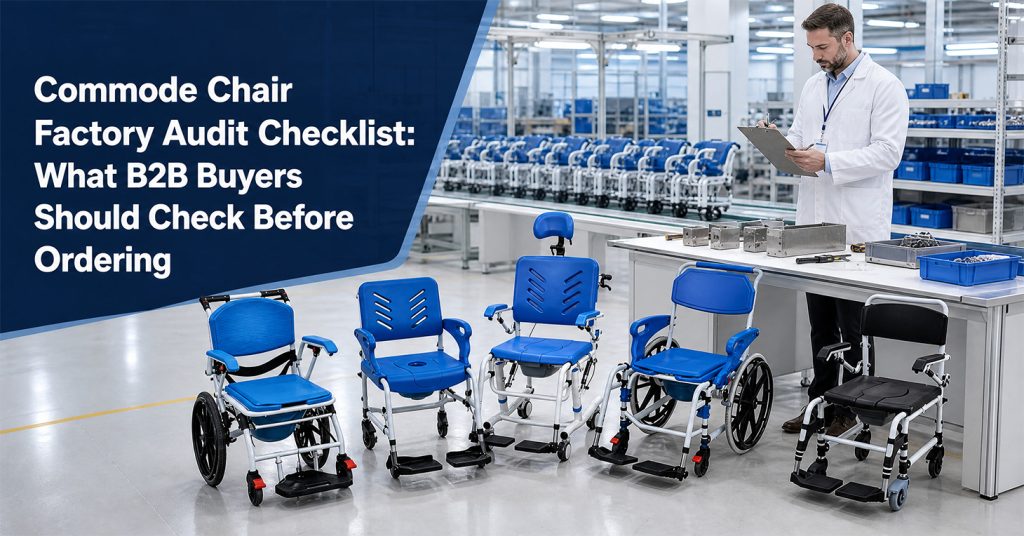
Choosing a reliable commode chair manufacturer requires more than comparing product prices, catalogs, or certificates.
For healthcare distributors, importers, wholesalers, and medical brands, a factory audit provides an opportunity to verify how a supplier actually operates. Instead of relying only on information presented in a quotation or on a website, buyers can evaluate the manufacturer’s production capabilities, quality management, product development resources, and ability to support long-term orders.
For buyers sourcing commode chairs from China, a factory audit does not necessarily require a visit in person. Depending on the project, an on-site audit, virtual factory tour, document review, or third-party inspection can all provide useful information.
This checklist explains the key areas B2B buyers should evaluate when auditing a commode chair manufacturer before placing a substantial order.
Why Should Buyers Audit a Commode Chair Manufacturer?
A factory audit helps buyers answer a fundamental question:
Can this supplier consistently manufacture and supply the product I need?
A professional factory audit can help buyers evaluate:
- Whether the supplier has relevant manufacturing capabilities
- Whether production resources are suitable for the expected order volume
- How product quality is controlled
- Whether the factory can support customized requirements
- Whether the manufacturer has the resources for repeat production
- Whether the supplier is suitable for a long-term B2B relationship
For a standard product, the audit may be relatively straightforward. For OEM or ODM projects, however, buyers should evaluate the manufacturer’s engineering, tooling, customization, and production capabilities as well.
1. Verify the Manufacturer’s Factory and Product Focus
The first step is to understand what the company actually manufactures.
A supplier may offer dozens or hundreds of healthcare products, but that does not necessarily mean it has strong manufacturing capabilities in every category.
For a commode chair project, buyers should ask:
- Is commode chair manufacturing one of the supplier’s core product categories?
- Does the company operate its own manufacturing facility?
- What types of commode chairs does it produce?
- How long has the manufacturer been producing rehabilitation or bathroom safety equipment?
- Which production processes are handled internally?
- Can the manufacturer provide a factory tour or audit?
Buyers should also compare the products shown in the supplier’s catalog with what is visible on the production floor.
A manufacturer specializing in commode chairs should be able to explain its product structures, materials, components, manufacturing processes, and customization options clearly.
2. Review the Quality Management System

A factory audit should go beyond checking whether a certificate is displayed on the wall.
For medical and rehabilitation equipment manufacturers, buyers should understand how the quality management system is applied in daily operations.
Depending on the supplier and product, buyers may review:
- Quality management system certification
- Quality procedures
- Incoming material inspection
- In-process inspection
- Final product inspection
- Handling of non-conforming products
- Corrective and preventive actions
- Quality documentation and records
ISO 13485 is an important quality management standard for medical device manufacturers. However, certification itself should not be treated as proof that every product is automatically defect-free.
The more useful question is:
How does the manufacturer apply its quality management system to the actual product being purchased?
3. Check Incoming Material and Component Control
Product quality starts with the materials and components entering the factory.
For commode chairs, buyers may want to understand how the manufacturer manages materials and components such as:
- Metal tubing and frame materials
- Plastic components
- Seats and backrests
- Casters and wheels
- Brakes
- Footrests
- Fasteners
- Packaging materials
During an audit, buyers can ask:
- How are suppliers selected and evaluated?
- Are incoming materials inspected?
- Are specifications documented?
- How are non-conforming materials identified and handled?
- How are important components controlled between receiving and production?
This is especially important for OEM projects, where a change in materials or components may affect the approved product.
4. Inspect the Production Process
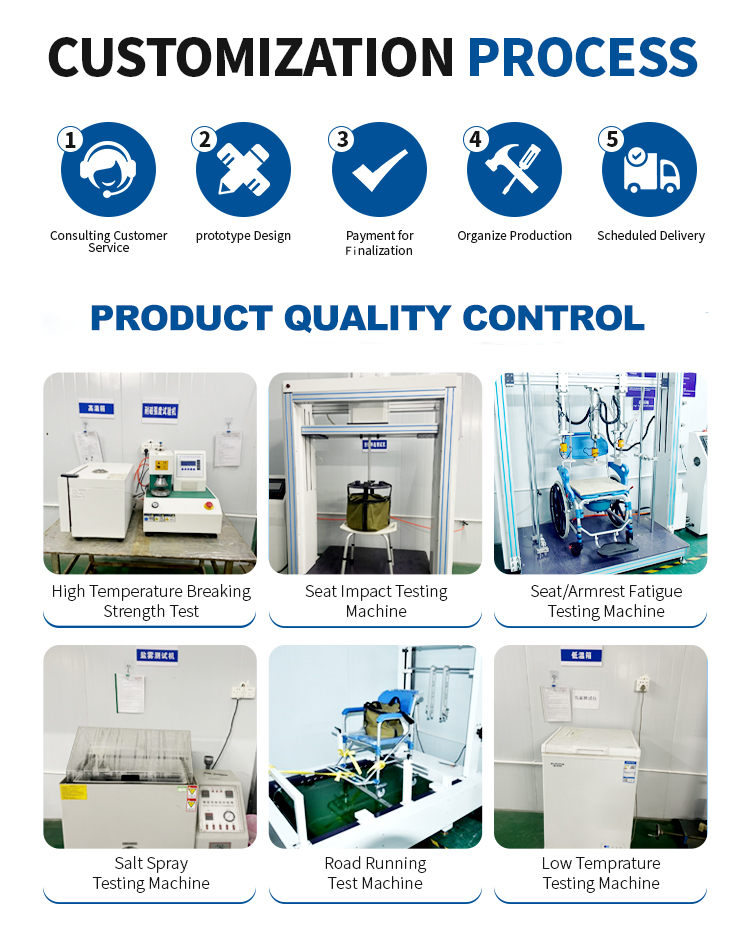
The production floor can provide information that a product catalog cannot.
During a factory audit, buyers should observe whether the manufacturing process is organized and whether production follows defined procedures.
For commode chairs, relevant areas may include:
Frame manufacturing
Review how frames are formed, welded, assembled, and inspected.
Surface treatment
Depending on the product, this may include coating, finishing, or other surface treatment processes.
Component assembly
Check how seats, armrests, footrests, casters, brakes, and other components are installed.
Final assembly
Observe whether operators follow standardized procedures and whether completed products are inspected before packaging.
The purpose of an audit is not to judge a factory simply by whether the production floor looks modern.
Instead, buyers should look for evidence that the manufacturer has controlled and repeatable production processes.
5. Evaluate Product Inspection and Functional Testing
For commode chairs, functional performance is an important part of product evaluation.
Depending on the specific model, buyers may review how the manufacturer checks:
- Overall stability
- Frame integrity
- Wheel and caster operation
- Braking functions
- Folding mechanisms
- Height adjustment
- Armrest and footrest functions
- Seat and bucket installation
- Other model-specific functions
The exact inspection and testing requirements should be based on the product design, applicable standards, and agreed specifications.
For B2B buyers, it is useful to ask the manufacturer:
What inspections are performed before products are released for shipment?
A strong supplier should be able to explain its inspection process clearly rather than simply stating that products are “100% quality checked.”
6. Check Product Specifications and Sample-to-Production Control
For distributors and OEM buyers, consistency between the approved sample and mass production is particularly important.
During an audit, buyers should ask how the manufacturer controls:
- Product dimensions
- Materials
- Colors
- Components
- Product configuration
- Packaging
- Labels
- Branding requirements
For customized products, these details should be confirmed before mass production.
A clear specification sheet and approved sample can provide an important reference for subsequent production orders.
This is one reason why buyers should evaluate not only whether a manufacturer can produce a sample, but also whether it has a system for reproducing the approved specification consistently.
7. Evaluate OEM and Product Development Capabilities

If you are purchasing standard products, manufacturing capability may be your primary concern.
For OEM and ODM buyers, engineering and product development capabilities become equally important.
Ask whether the manufacturer can support:
- Logo customization
- Packaging customization
- Product color changes
- Component changes
- Product configuration changes
- New product development
- Tooling or mold development
- Product improvement projects
Buyers should also clarify which capabilities are handled internally and which are outsourced.
For long-term OEM cooperation, this can make a significant difference when a product needs to be modified or expanded for a particular market.
8. Review Production Capacity and Order Management
A factory audit should also assess whether the manufacturer can support your expected order volume.
Production capacity should not be evaluated solely by asking:
“How many units can you produce per month?”
Buyers should also consider:
- Current production schedules
- Number of product models being manufactured
- Production processes
- Material availability
- Customization requirements
- Expected order volume
- Repeat order requirements
- Lead-time management
For example, a manufacturer may have sufficient theoretical capacity but limited availability during peak production periods.
For long-term B2B cooperation, buyers should therefore evaluate both production capacity and production planning.
KDB Medical has more than 14 years of experience in rehabilitation equipment manufacturing and operates an approximately 18,000 m² manufacturing facility.
Commode chairs are one of our core product categories, with production capacity of up to 80,000 units per month depending on product models and production requirements.
9. Review Documentation and Market Requirements
The documentation required for a commode chair depends on the product and destination market.
Buyers should discuss the documentation applicable to their specific project rather than requesting a generic list of “certificates.”
Depending on the market and product, documentation may include:
- Quality management system certification
- Product specifications
- Applicable conformity documentation
- Relevant test reports
- Material or component documentation where applicable
- Inspection records agreed for the order
- Shipping and product documentation required by the destination market
For international B2B orders, buyers should confirm these requirements before placing an order.
Regulatory requirements can differ between markets, so buyers should also verify the applicable requirements in their own country.
10. Evaluate Packaging and Shipment Preparation
A product can pass factory inspection and still be damaged during transportation if packaging is not suitable for the shipping method.
During a factory audit, buyers can review:
- Packaging materials
- Product protection
- Carton construction
- Internal protection
- Labeling
- Palletization, where applicable
- Container loading practices
For distributors importing larger quantities, packaging efficiency is also important because packaging dimensions can affect container utilization and shipping costs.
The buyer should confirm packaging requirements before mass production, particularly for private-label and OEM projects.
11. Evaluate Communication and Long-Term Cooperation
A factory audit should not focus entirely on machines and production lines.
Communication is also part of supplier evaluation.
Before establishing a long-term relationship, buyers should evaluate:
- Response speed
- Technical communication
- Ability to understand product requirements
- Handling of specification changes
- Sample development communication
- Production updates
- Problem-solving ability
- After-sales communication
A manufacturer may have good production equipment but still be difficult to work with if product specifications, changes, and expectations are not communicated clearly.
For international B2B buyers, reliable communication can become especially important when managing customized products or repeat orders.
12. Use a Practical Factory Audit Checklist
Before approving a commode chair manufacturer, buyers can organize their evaluation into the following categories:
| Audit Area | Key Questions |
|---|---|
| Factory capability | Does the manufacturer have relevant commode chair production capabilities? |
| Product focus | Is commode chair manufacturing a core product category? |
| Quality system | Is there a structured quality management system? |
| Materials | How are incoming materials and components controlled? |
| Production | Are manufacturing processes standardized and controlled? |
| Product inspection | What inspections and functional checks are performed? |
| Sample control | How is the approved sample transferred to mass production? |
| OEM/ODM | Can the manufacturer support customization and product development? |
| Capacity | Can the factory support your expected order volume and repeat orders? |
| Documentation | Can relevant product and market documentation be provided? |
| Packaging | Is packaging suitable for storage and international transportation? |
| Communication | Can the supplier provide clear and consistent project support? |
This checklist can be used during an on-site factory visit, virtual factory audit, or supplier evaluation process.
Factory Audit Is About Verifying Capability, Not Just Collecting Certificates
A factory audit should answer more than whether a manufacturer has the right certificates.
For distributors, importers, wholesalers, and OEM buyers, the more important questions are:
Can the manufacturer produce the required product consistently?
Can it support the required order volume?
Can it manage product customization?
Can it maintain the agreed specifications across repeat orders?
Can it provide appropriate documentation for the target market?
Can it become a reliable long-term manufacturing partner?
For buyers sourcing commode chairs from China, evaluating these areas before a major order can help reduce sourcing risks and create a stronger foundation for long-term cooperation.
Evaluate KDB Medical as Your Commode Chair Manufacturing Partner
KDB Medical specializes in the manufacturing of commode chairs and related bathroom safety equipment for global B2B customers.
With more than 14 years of manufacturing experience and an approximately 18,000 m² manufacturing facility, KDB Medical supports distributors, wholesalers, healthcare brands, and OEM buyers with standard and customized commode chair programs.
Our commode chair manufacturing capabilities cover multiple product configurations, including bedside commode chairs, folding models, shower commode chairs, wheeled commode chairs, and bariatric options.
For buyers evaluating a potential manufacturing partner, we can support factory communication, product selection, sample evaluation, OEM/ODM discussions, and customized product requirements.
Contact KDB Medical to discuss your commode chair sourcing requirements, request product information, evaluate OEM opportunities, or discuss a factory audit.
