
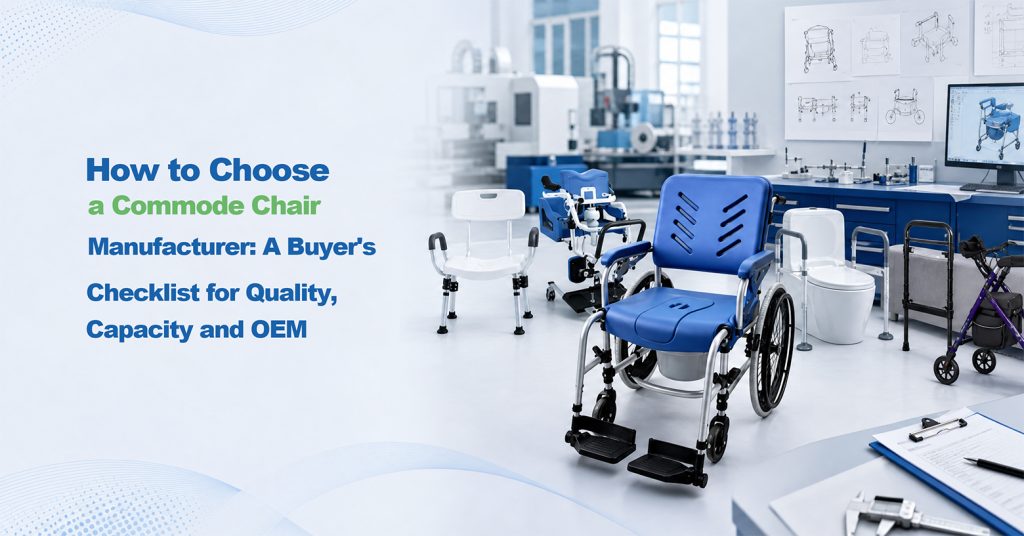
Finding a commode chair supplier online is relatively easy. Choosing a manufacturing partner that can consistently support product quality, stable production, customization, and long-term supply is a more important decision.
For healthcare distributors, importers, wholesalers, and medical brands, a commode chair is not simply a product to purchase once. It is often part of a broader bathroom safety or rehabilitation equipment portfolio. A manufacturing partner may therefore influence product consistency, supply reliability, customization options, and the long-term competitiveness of your product range.
This guide explains the key factors B2B buyers should consider when evaluating a commode chair manufacturer, from factory capabilities and product quality to OEM requirements and long-term supply.
1. Confirm Whether You Are Working With a Manufacturer or a Trading Company
Both manufacturers and trading companies can serve different sourcing needs. A trading company may offer access to a wider range of products from multiple suppliers, while working directly with a manufacturer may provide advantages for buyers who require product specialization, customization, or long-term production support.
If your business requires OEM development, private labeling, customized packaging, or consistent repeat orders, it is useful to understand who is actually responsible for manufacturing the product.
When evaluating a potential supplier, buyers can ask questions such as:
- Does the company operate its own manufacturing facility?
- Is commode chair production one of its core product categories?
- Can the supplier provide information about its production processes?
- Does the company have product development and engineering capabilities?
- Can factory audits or virtual factory visits be arranged?
- Does the manufacturer control product development, production, and quality processes internally?
A supplier’s website, product range, factory information, and communication process can also provide useful insights.
The goal is not simply to determine whether a company is a factory or trading company. Buyers should understand whether the supplier has the capabilities required for their specific sourcing project.
2. Evaluate Product Quality and Manufacturing Control
A commode chair may appear simple, but product quality depends on multiple details, including materials, frame construction, assembly, stability, functionality, and component consistency.
For distributors and importers, product quality should be evaluated beyond catalog images or product descriptions.
Important areas to review include:
Frame and Structural Design
The frame is one of the most important elements of a commode chair. Buyers should evaluate the material, tube construction, connection points, and overall structural design according to the intended application.
Different products may be designed for home care, elderly care, healthcare facilities, rehabilitation environments, or users requiring higher weight capacities.
Materials and Components
Materials and components can influence durability, user comfort, maintenance, and long-term performance.
Depending on the product design, buyers may need to review:
- Frame materials
- Seat and backrest materials
- Armrests
- Footrests
- Casters
- Height-adjustment components
- Folding mechanisms
- Commode buckets and lids
It is important to confirm that the product configuration matches the approved specifications before bulk production.
Product Stability and Function
Buyers should evaluate how the product performs during normal use.
For example, depending on the model, important functions may include:
- Folding and unfolding
- Height adjustment
- Wheel movement and braking
- Armrest or footrest operation
- Seat installation and removal
- Overall stability
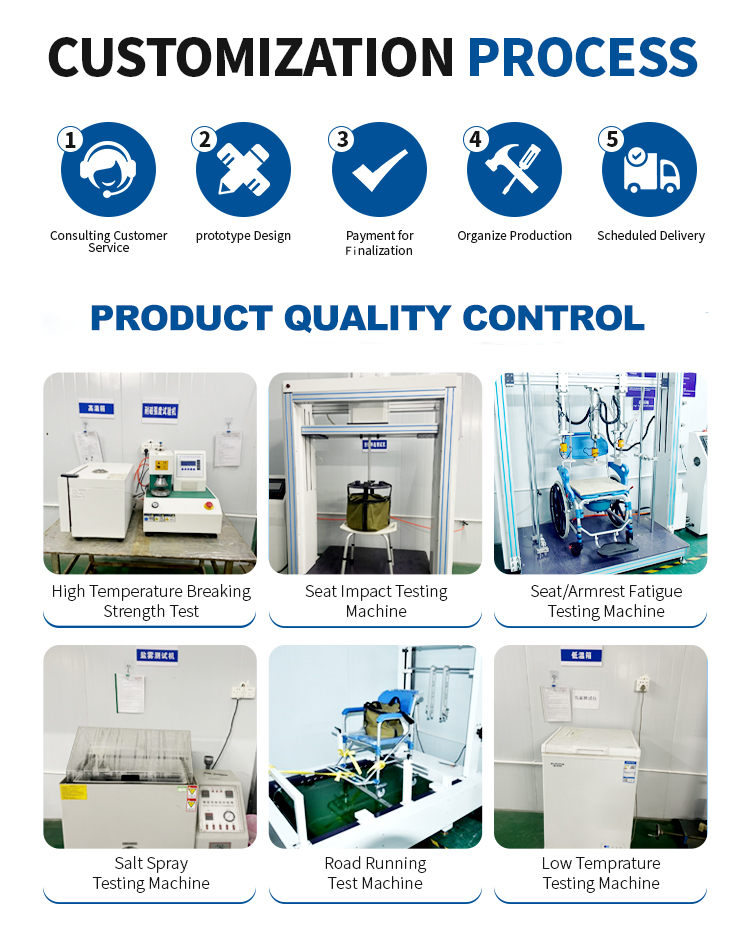
The inspection and testing requirements should be discussed according to the specific product and intended market.
3. Check the Manufacturer’s Product Range
A specialized manufacturer should be able to support different product requirements rather than offering only one basic model.
For distributors building a bathroom safety product portfolio, it can be useful to work with a manufacturer that offers multiple commode chair categories.
Common categories include:
- Standard bedside commode chairs
- Folding commode chairs
- 3-in-1 commode chairs
- Shower commode chairs
- Wheeled commode chairs
- Bariatric commode chairs
A broader product range allows distributors to serve different customer segments and price levels.
For example, a distributor may offer an entry-level model for general home care, while also supplying higher-capacity or wheeled models for healthcare facilities and professional care environments.
Working with a manufacturer that specializes in commode chairs can also make it easier to compare product configurations and develop a more structured product portfolio.
4. Evaluate Production Capacity and Supply Stability
Production capacity should be considered together with product complexity, order volume, customization requirements, and delivery schedules.
A manufacturer with sufficient production capacity may be better positioned to support:
- Repeat orders
- Seasonal demand
- Larger distribution programs
- Multiple product models
- Long-term supply planning
However, buyers should not evaluate capacity based only on a number displayed on a website.
Useful questions include:
- What is the manufacturer’s core production capacity?
- Which production processes are handled internally?
- How does the factory manage multiple orders at the same time?
- How are production schedules planned?
- Can the manufacturer support repeat orders for the same product configuration?
- How are customized projects managed alongside standard production?
For long-term cooperation, consistent supply can be just as important as the initial quotation.
At KDB Medical, commode chairs are a core manufacturing category. With more than 14 years of manufacturing experience and an approximately 18,000 m² manufacturing facility, we support global B2B customers with a broad range of commode chair products and manufacturing solutions.
Our production capacity can support up to 80,000 commode chairs per month, depending on product models and production requirements.
5. Ask About OEM and Customization Capabilities

OEM requirements can vary significantly between customers.
Some distributors may only require logo printing and customized packaging, while established medical brands may require product modifications, exclusive configurations, or new product development.
Before choosing a manufacturer, buyers should understand what level of customization is available.
Possible OEM or customization requirements may include:
- Logo and branding
- Customized packaging
- Product colors
- Product configuration
- Accessories
- Product labeling
- User manuals
- Customized product development
For more complex projects, buyers may also need support with product design and engineering development.
It is important to clarify customization requirements before requesting a quotation because product modifications may affect tooling, materials, production processes, minimum order quantities, and lead times.
A good manufacturing partner should help the buyer understand which customization options are practical for the project rather than simply promising that “everything can be customized.”
6. Understand Samples, MOQ, and Bulk Order Requirements
MOQ requirements are not always the same for every commode chair project.
The required quantity may depend on:
- Product model
- Existing or customized design
- Color requirements
- Packaging requirements
- Branding
- New components or tooling
- Production planning
For this reason, buyers should avoid assuming that one MOQ applies to all products.
Before placing a bulk order, it is often useful to confirm:
Product Samples
Samples allow buyers to evaluate product design, materials, workmanship, dimensions, functionality, and packaging.
For OEM projects, the approved sample can also help both parties confirm the product configuration before mass production.
Product Specifications
Buyers should provide clear requirements covering the product configuration, dimensions, materials, colors, accessories, packaging, and branding requirements.
Minimum Order Quantity
MOQ should be discussed according to the specific product and level of customization.
A standard product may have different requirements from a customized OEM project.
Production Lead Time
Lead time may vary depending on order quantity, product complexity, production schedules, and material availability.
Clear communication before order confirmation can help avoid misunderstandings later in the production process.
7. Review Relevant Quality Systems and Product Documentation
Quality documentation should always be evaluated according to the specific product and destination market.
Rather than simply requesting a general list of certificates, buyers should confirm what documentation is relevant to their sourcing project.
Depending on the product and market, this may include:
- Evidence of applicable quality management system certification
- Product specifications
- Relevant conformity or regulatory documentation
- Applicable test reports
- Material or component documentation, where relevant
- Agreed inspection or quality records
For example, ISO 13485 is a quality management system standard used by medical device manufacturers. Buyers should understand what the certification covers and how the manufacturer’s quality system is implemented in actual production.
Regulatory and conformity requirements may also vary depending on the product and destination market.
Before placing an order, buyers should confirm the applicable requirements for their specific product and target market.
8. Evaluate Communication and Project Support
A manufacturer’s ability to produce a product is important, but communication can also determine whether a sourcing project runs smoothly.
For international B2B buyers, clear communication is particularly important during:
- Product selection
- Quotation
- Sample development
- OEM confirmation
- Production planning
- Packaging approval
- Shipment preparation
- Repeat orders
A reliable manufacturing partner should be able to clearly communicate product specifications, project requirements, production considerations, and potential issues.
Before beginning a long-term cooperation, buyers can evaluate how the supplier handles technical questions and changes.
Useful questions include:
- Are product specifications clearly confirmed?
- Are customization requirements documented?
- Does the supplier explain potential limitations?
- Are changes communicated before production?
- Is there a clear process for handling product issues?
The quality of communication during the quotation and sample stage can often provide useful insight into how the supplier may manage future projects.
9. Consider Long-Term Product Development Potential
The lowest unit price is not always the most important factor when choosing a manufacturing partner.
For distributors and brands planning to build a long-term commode chair category, the manufacturer should ideally be able to support future product development.
This may include:
- Expanding the product range
- Developing new configurations
- Improving existing products
- Supporting private-label programs
- Creating customized solutions for specific markets
Working with a long-term manufacturing partner can help distributors maintain a more consistent product portfolio and reduce the complexity of managing multiple suppliers.
For buyers planning to grow their business, it is worth evaluating not only what a manufacturer can supply today, but also what the manufacturer may be able to support in the future.
A Practical Checklist for Choosing a Commode Chair Manufacturer
Before selecting a supplier, B2B buyers can use the following checklist:
Factory Capability
- Does the supplier have manufacturing capabilities relevant to your product?
- Is commode chair production a core category?
- Can the factory support your expected order volume?
Product Quality
- Are product specifications clearly defined?
- Can you evaluate samples before bulk production?
- Are important product functions and components reviewed?
Product Range
- Does the manufacturer offer different commode chair categories?
- Can the supplier support future product expansion?
OEM and Customization
- Are your branding and packaging requirements supported?
- Can the manufacturer handle product modifications or development projects?
Order Requirements
- Are MOQ, samples, lead time, and production requirements clearly explained?
- Are product specifications confirmed before mass production?
Documentation
- Can the manufacturer provide documentation relevant to the product and destination market?
Communication
- Are technical questions answered clearly?
- Does the supplier communicate limitations or changes?
- Can the manufacturer support repeat orders and long-term cooperation?
Choose a Manufacturing Partner, Not Just a Product Supplier
Choosing a commode chair manufacturer is not simply about finding the lowest price.
For distributors, importers, healthcare brands, and OEM buyers, the right manufacturing partner can support product quality, stable production, customization, and future product development.
The best approach is to evaluate the manufacturer as a long-term partner and consider how its product expertise, manufacturing capabilities, communication, and customization support align with your business requirements.
KDB Medical specializes in the manufacturing of commode chairs and related bathroom safety products for global B2B customers. With more than 14 years of manufacturing experience, a broad product portfolio, and OEM/ODM capabilities, we work with distributors, wholesalers, brands, and project buyers on standard and customized product programs.
If you are looking for a reliable commode chair manufacturing partner, contact our team to discuss product specifications, OEM/ODM requirements, samples, catalogs, pricing, or customized solutions for your market.
